

A premium theme and card library for Home Assistant.


Try it: acosta290.github.io/fluvy — the real cards, pages and settings panel on a simulated home, in your browser.
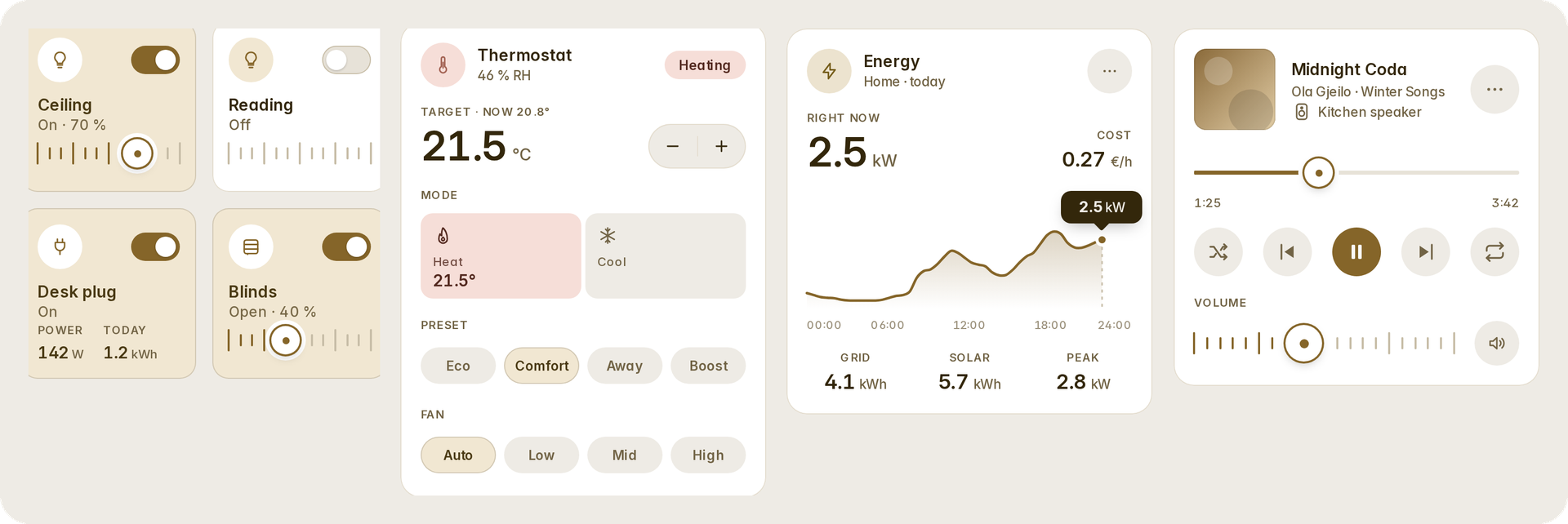
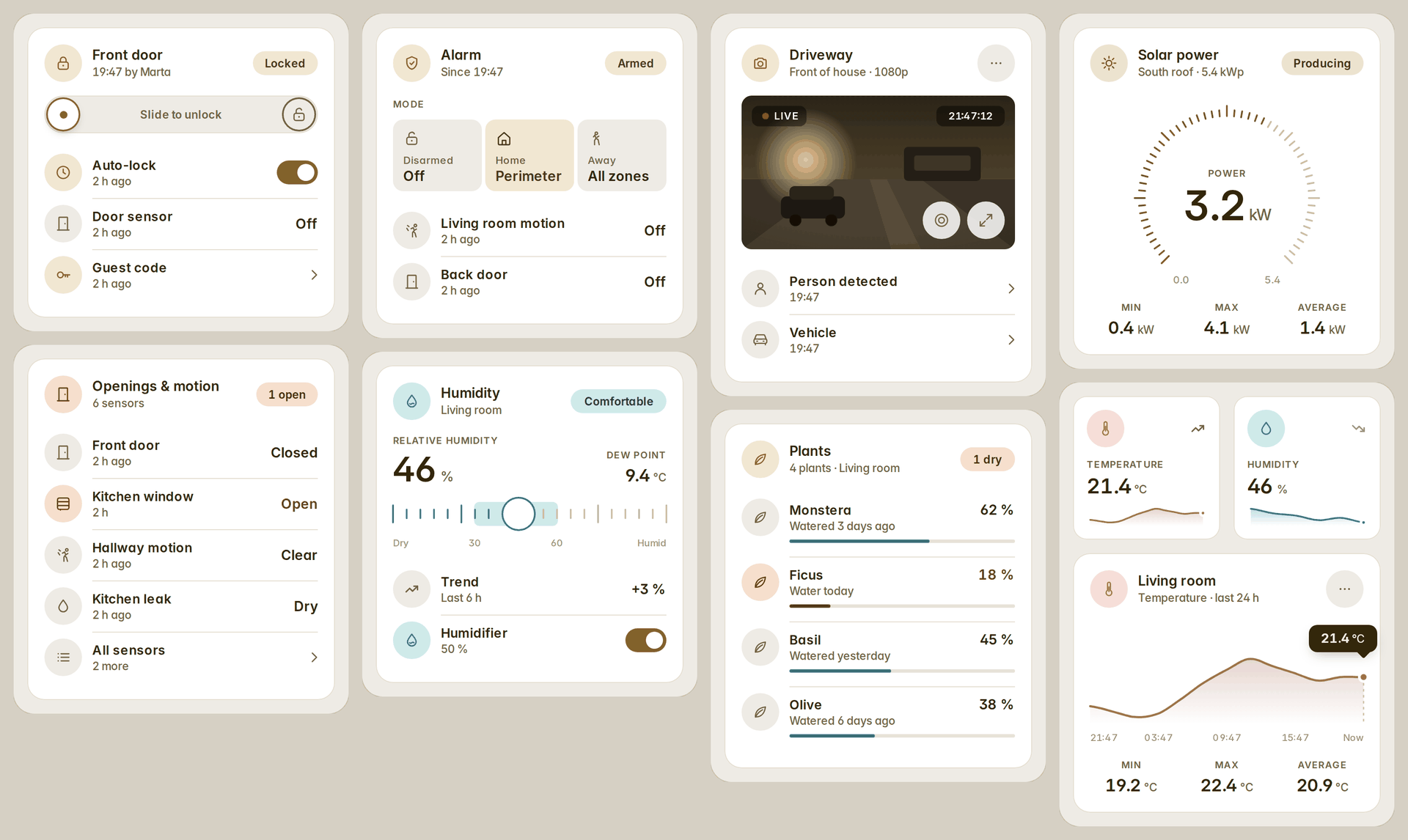
Fluvy brings one design to the whole of Home Assistant: a theme, forty-nine cards, five automatic dashboards, a settings panel, the Activity and History pages, and Home Assistant's own pages restyled to match — all from one set of design tokens, installed as one integration through HACS. Every card is drawn on a 4 px grid, checked by an alignment measurer, and holds from a phone to a wall tablet, in light and dark, in eight languages.
The sidebar, the header, the tabs, the dialogs, the settings pages: with the Fluvy theme on, Home Assistant looks like it was designed with the cards, because it was — the same tokens, the same type (Inter), the same radii and hairlines.
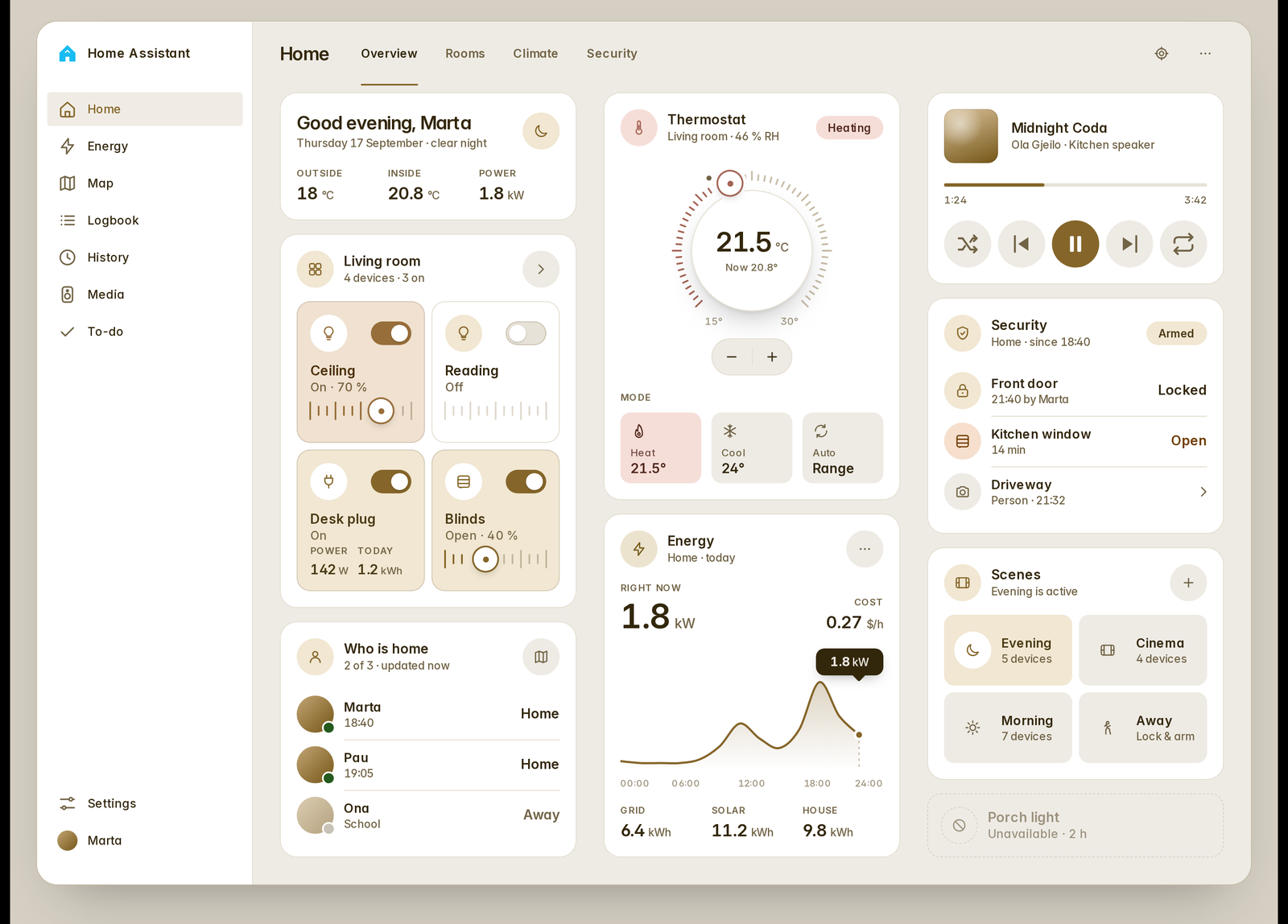
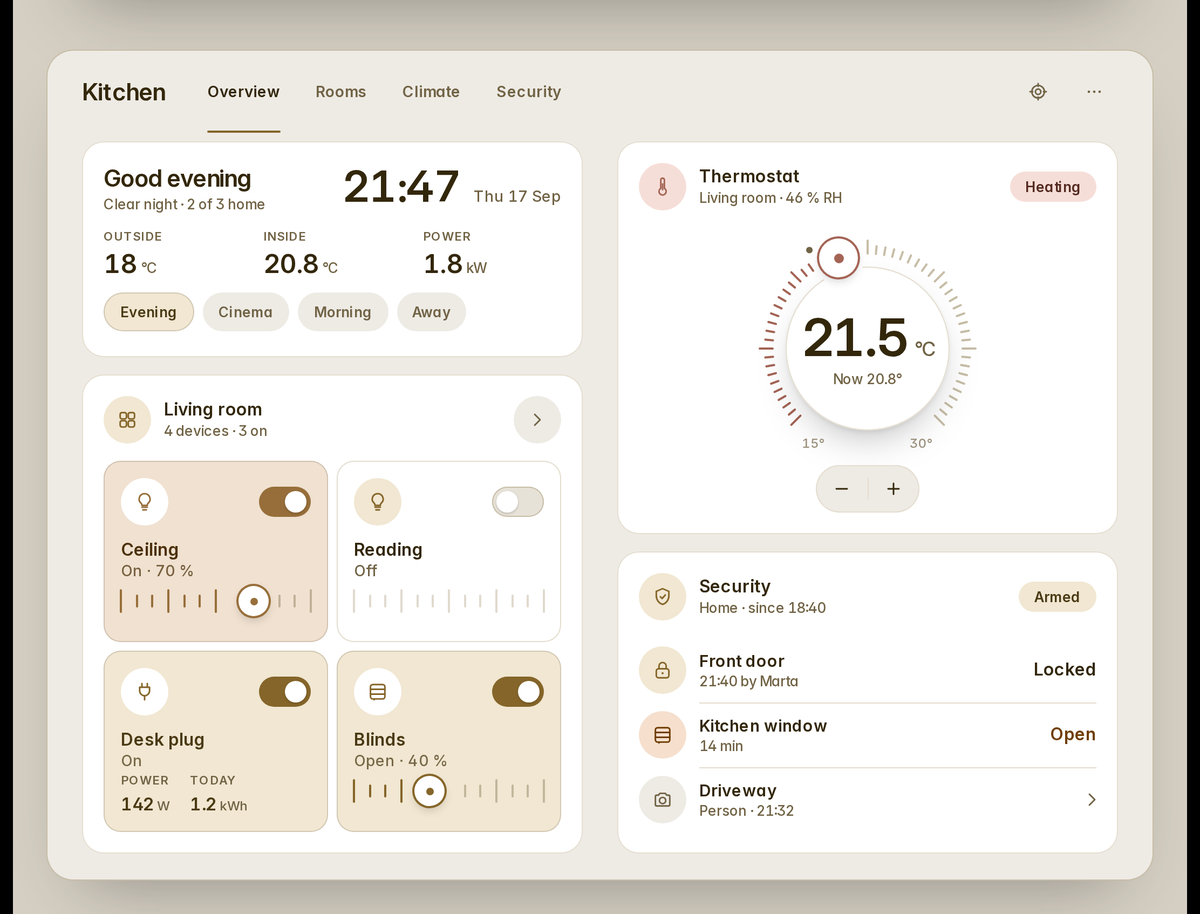
Every card has an editor form and a live preview in the card picker; every option is documented in the cards. Sliders and dials are precision controls: relative drag, slide away to slow down, hold for the 1 % scale.
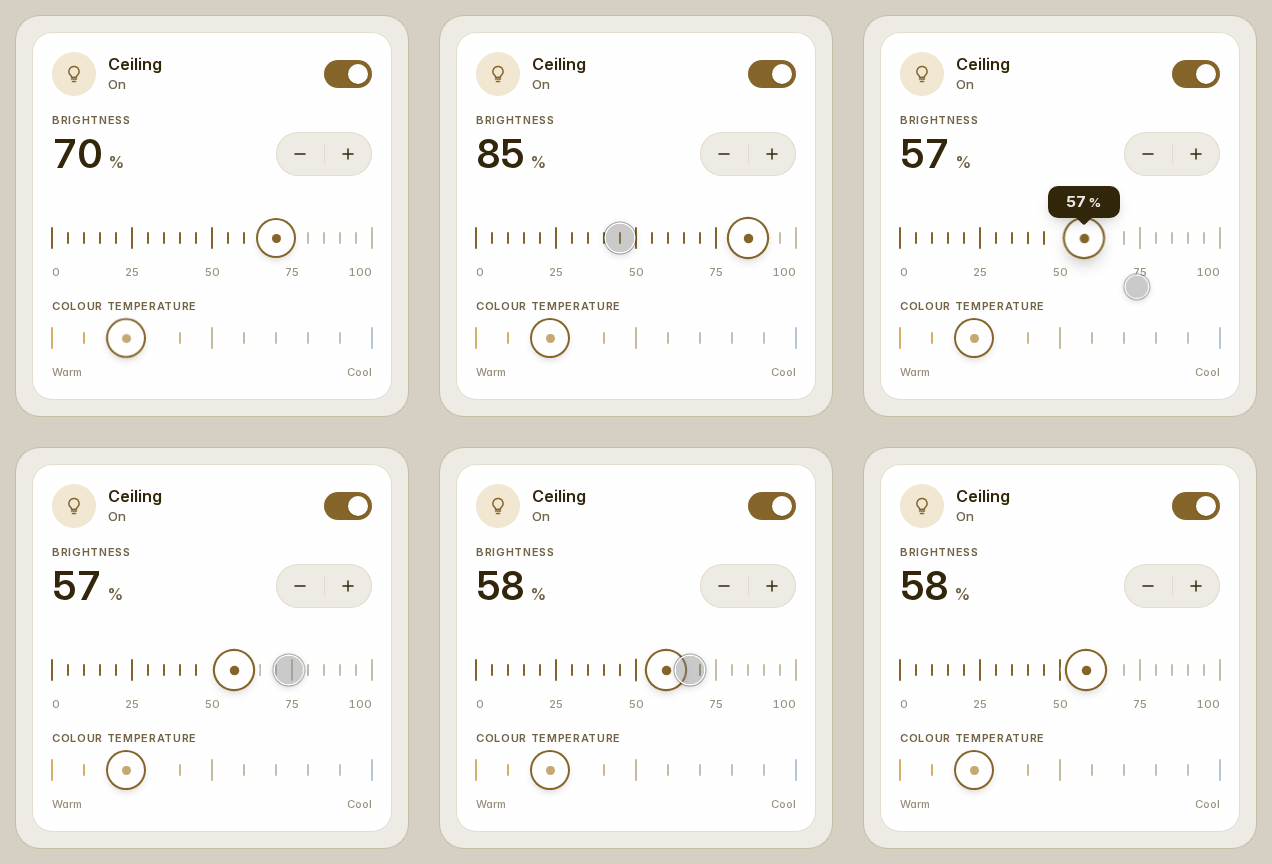
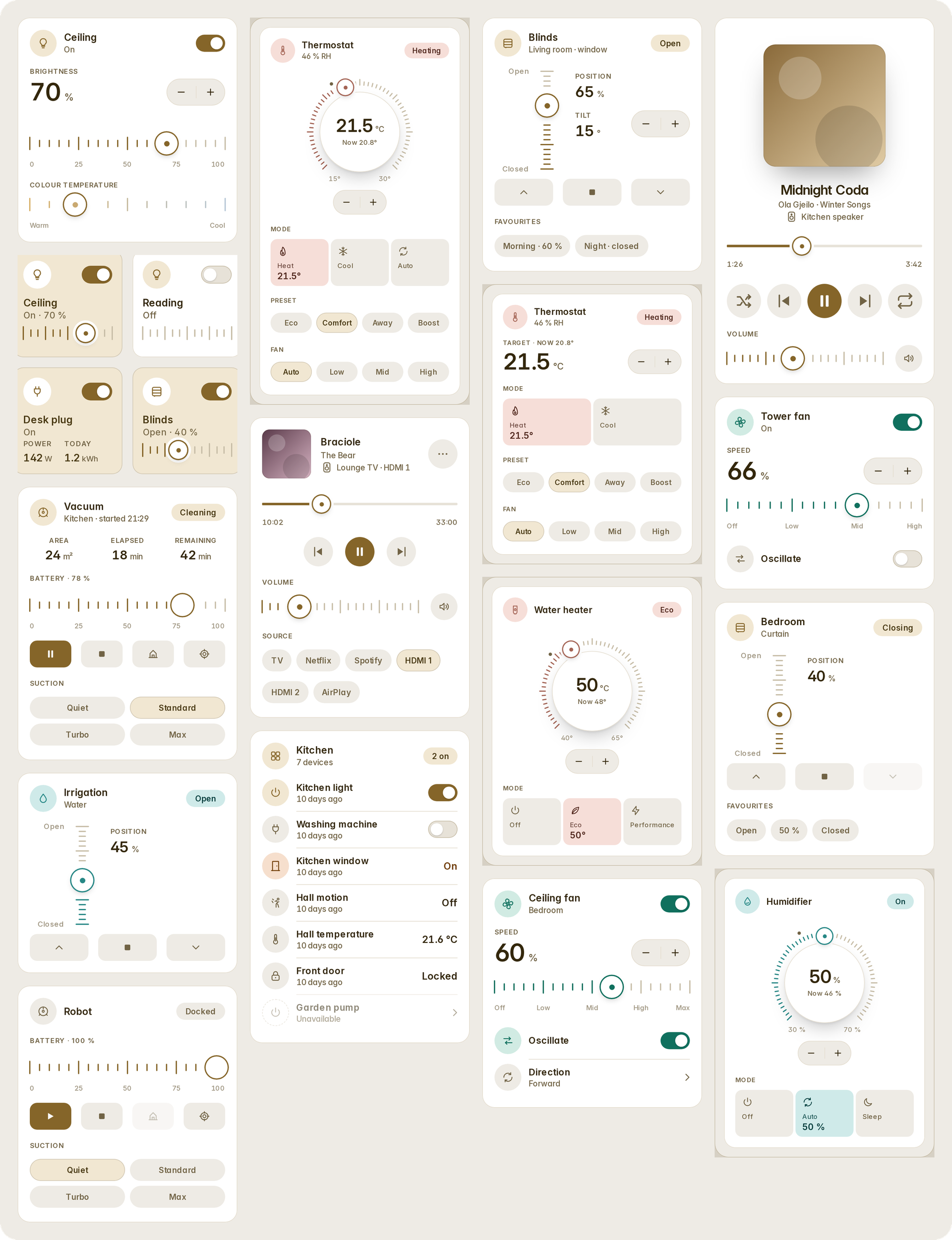
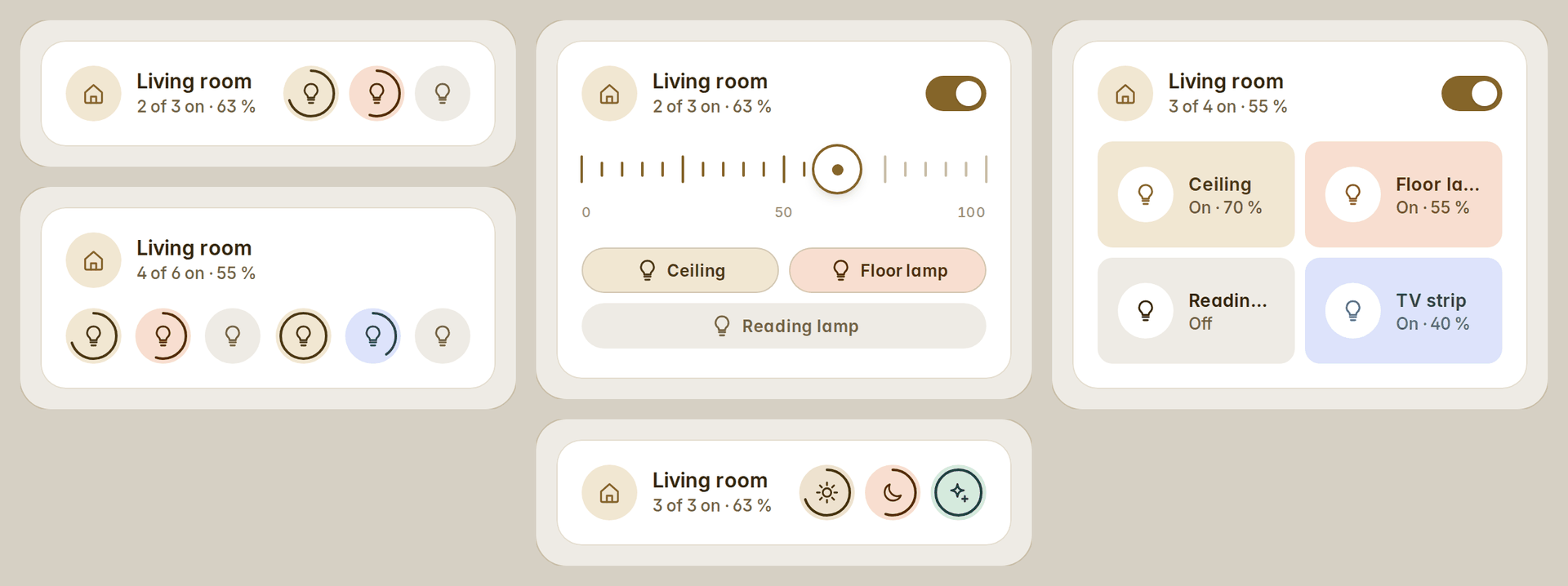
Control — lights with brightness and colour temperature, a room's lights on one card (one tap for the whole room, a round for each light, in its bulb's colour), thermostats (dial or compact), water heaters and humidifiers, covers with position and tilt, fans, vacuums, valves, media players and TVs, tiles and lists.
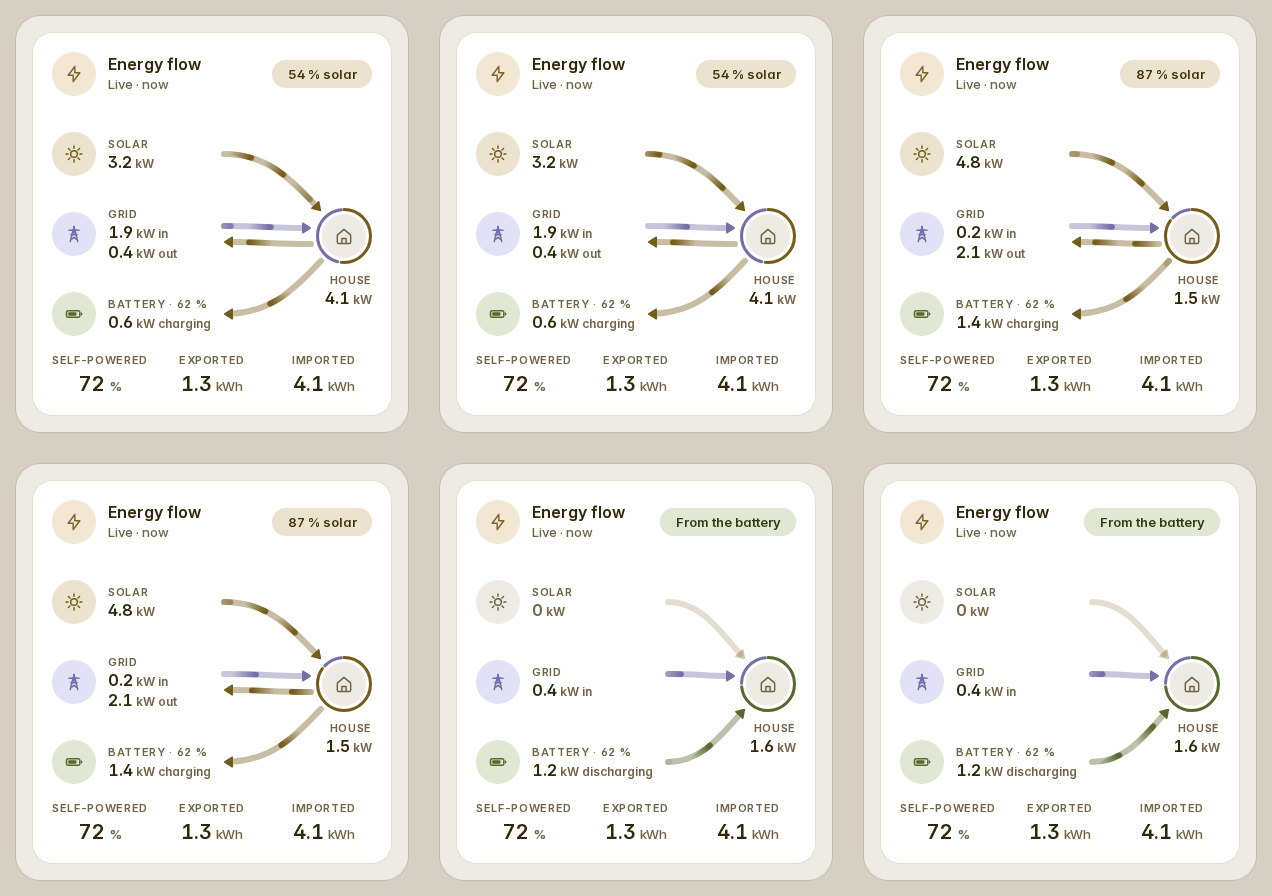
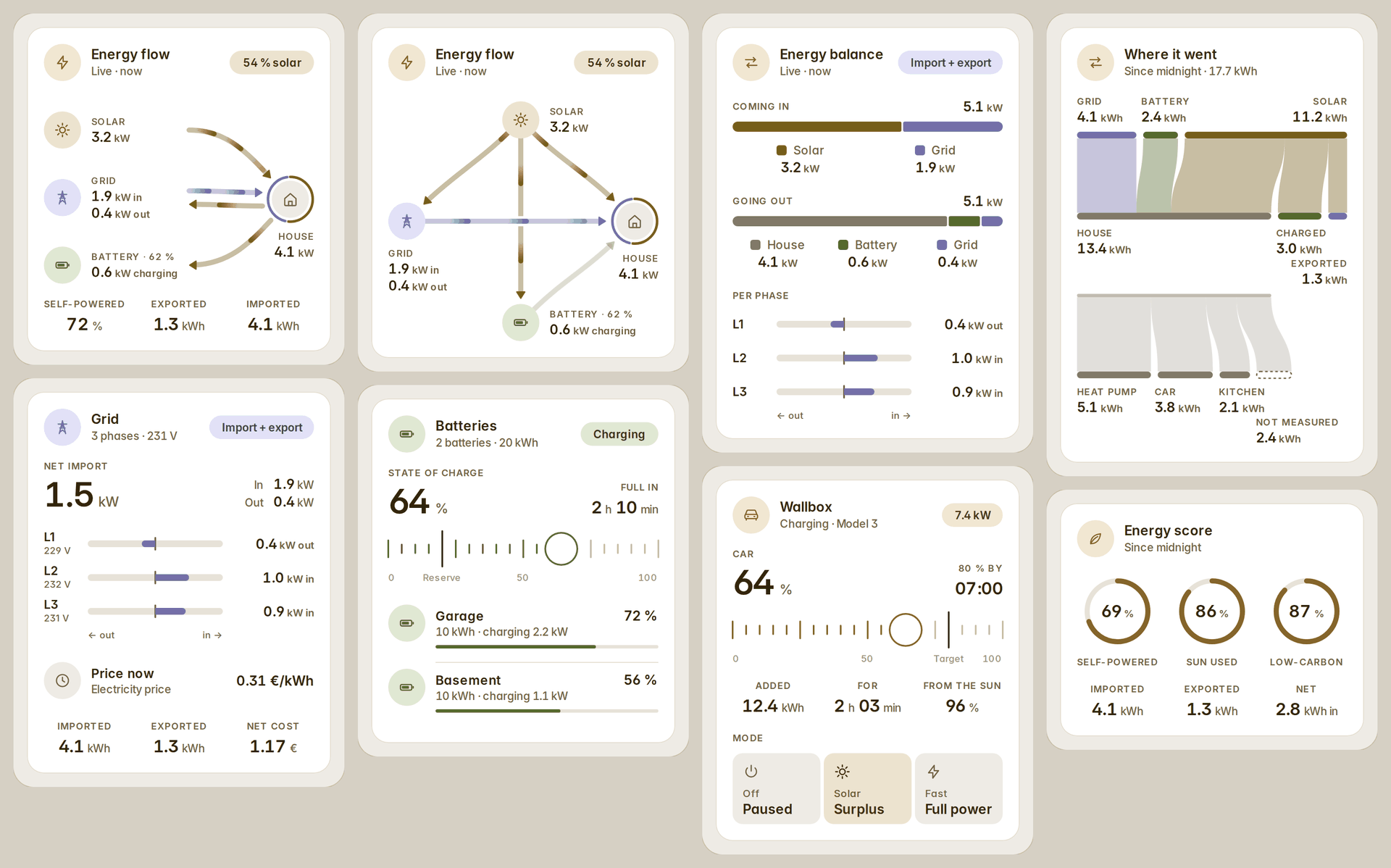
Energy — the energy flow, read the way your meters are: one sensor, import and export apart, or each phase — so a house that imports and exports at once shows both, every lane in the colour of where its energy came from, with the Energy dashboard's own sources when you give it none. Beside it: the balance of what comes in and goes out, the grid by phase, batteries, a car charger, where a day's energy went (a sankey), the score, water and gas, the house's power by source, solar by array, consumption by device and gauges for anything. How they read a house.
Security and sensors — locks, alarms, cameras, openings and motion, humidity, plants, gauges and sensor tiles.
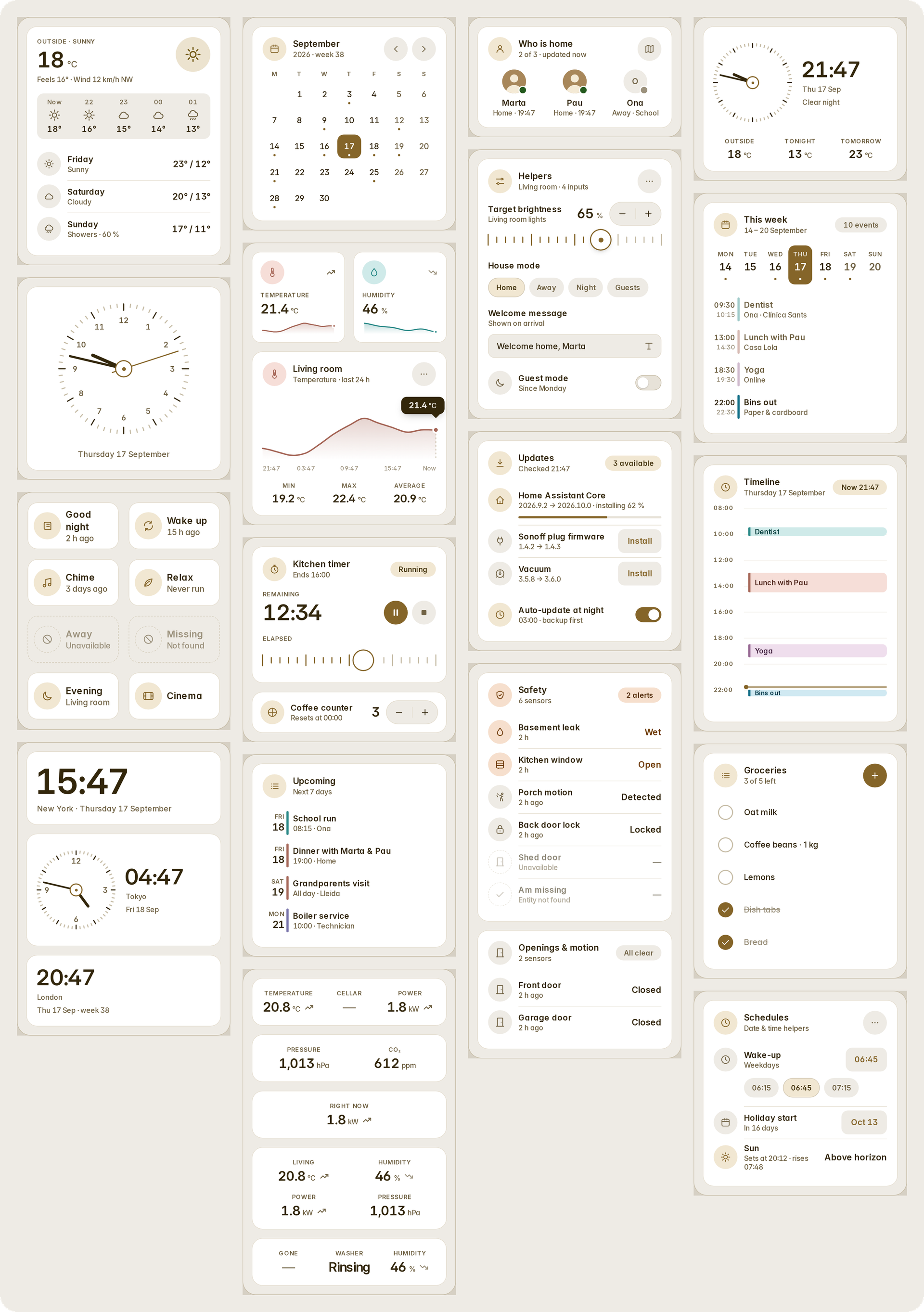
Home, time and helpers — weather and forecasts, who is home, scenes and actions, calendars (month, week, timeline, upcoming), clocks (analog, digital, world), readouts and trends, safety, helpers, updates, timers, schedules and to-do lists.
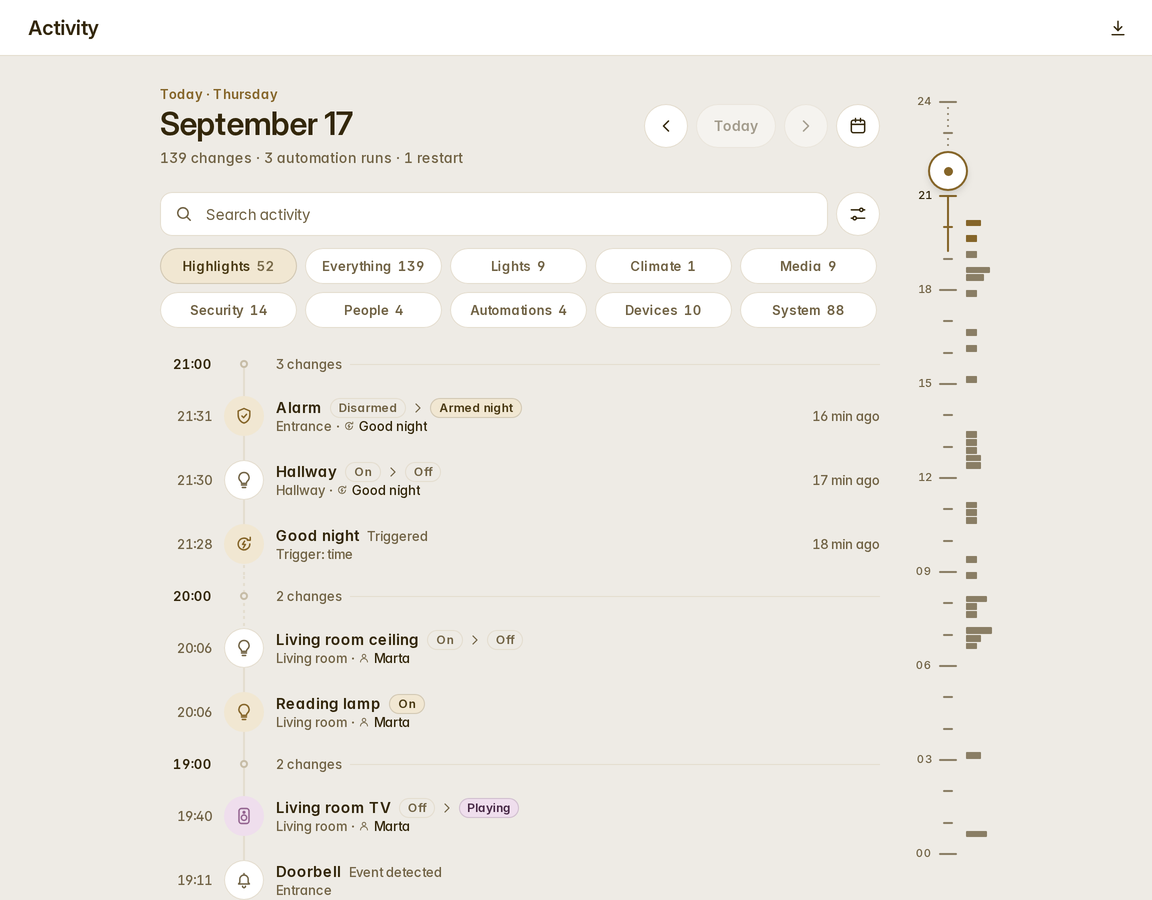
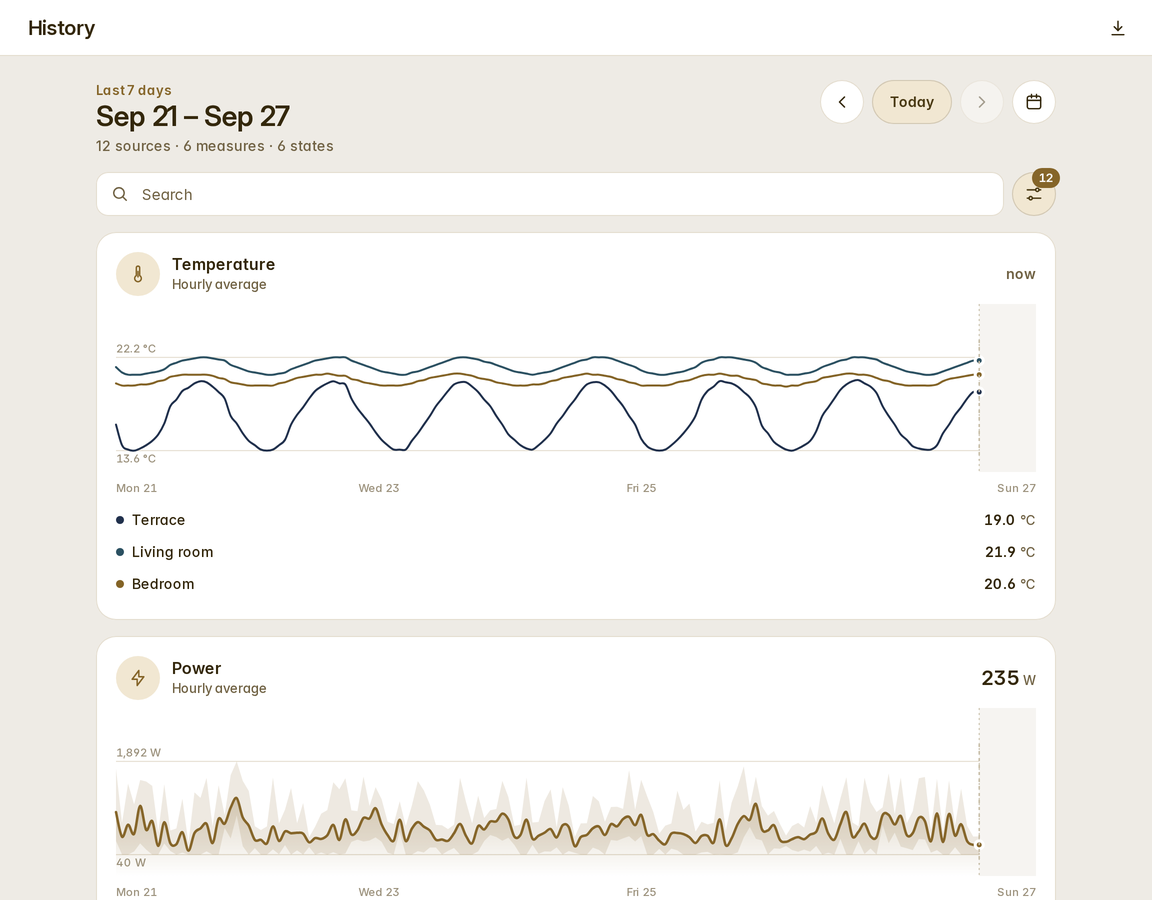
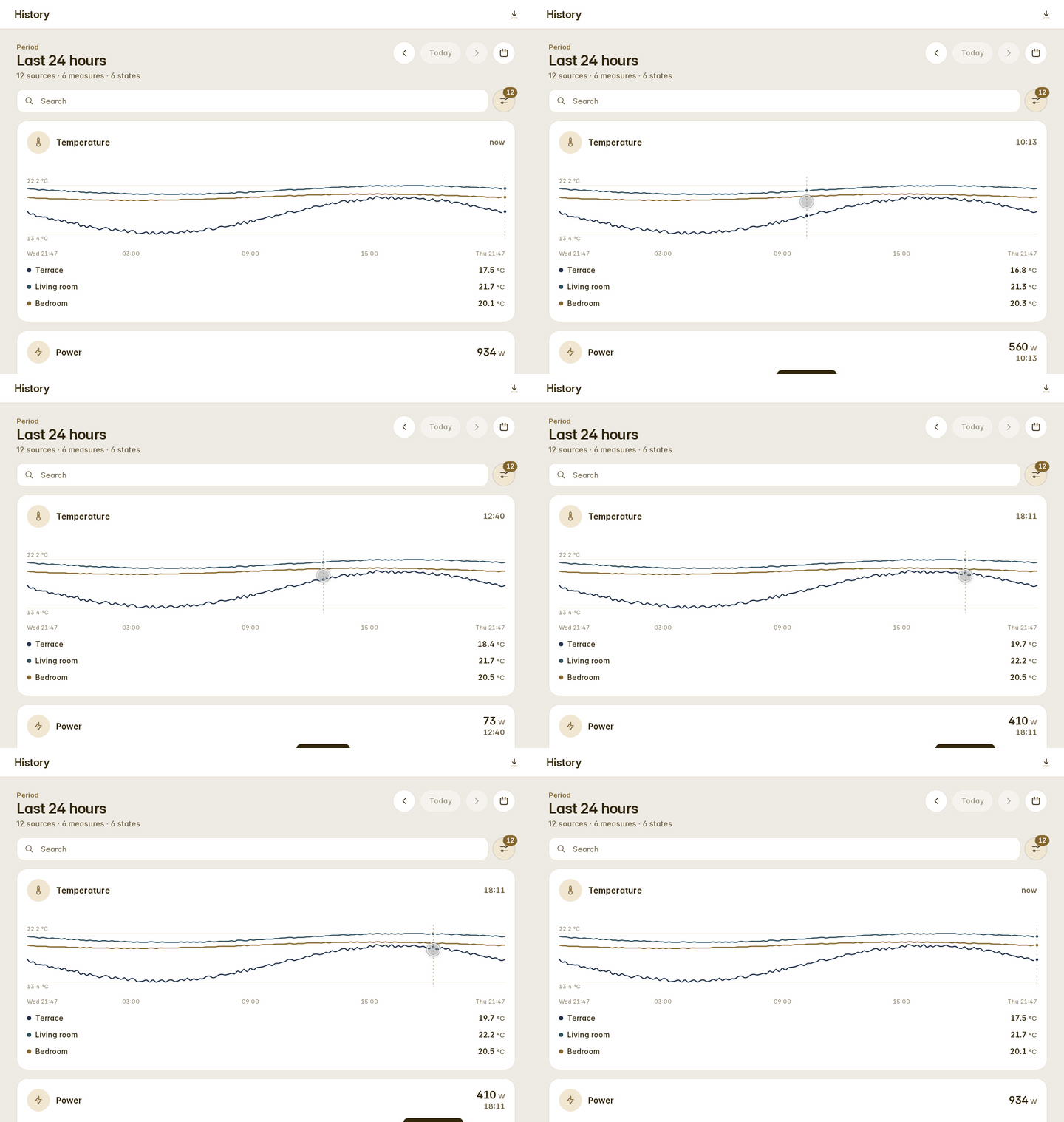
Two of Home Assistant's pages, drawn in the same idiom: the logbook as a timeline with who did what, and the history as charts with a scrub cursor, grouped by room or device. They stand in for the built-in pages while the house wants them; a switch gives Home Assistant's pages back.
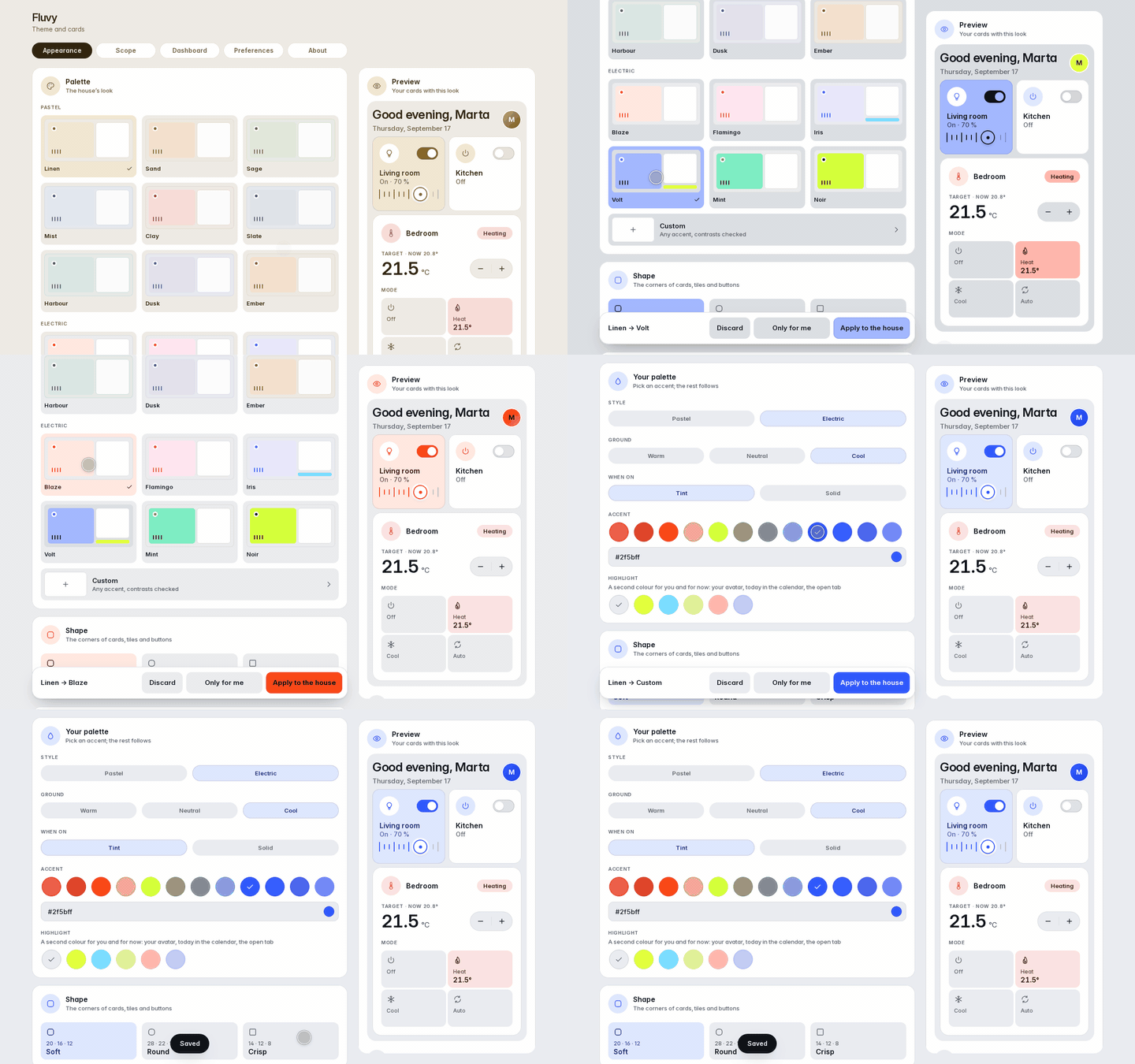
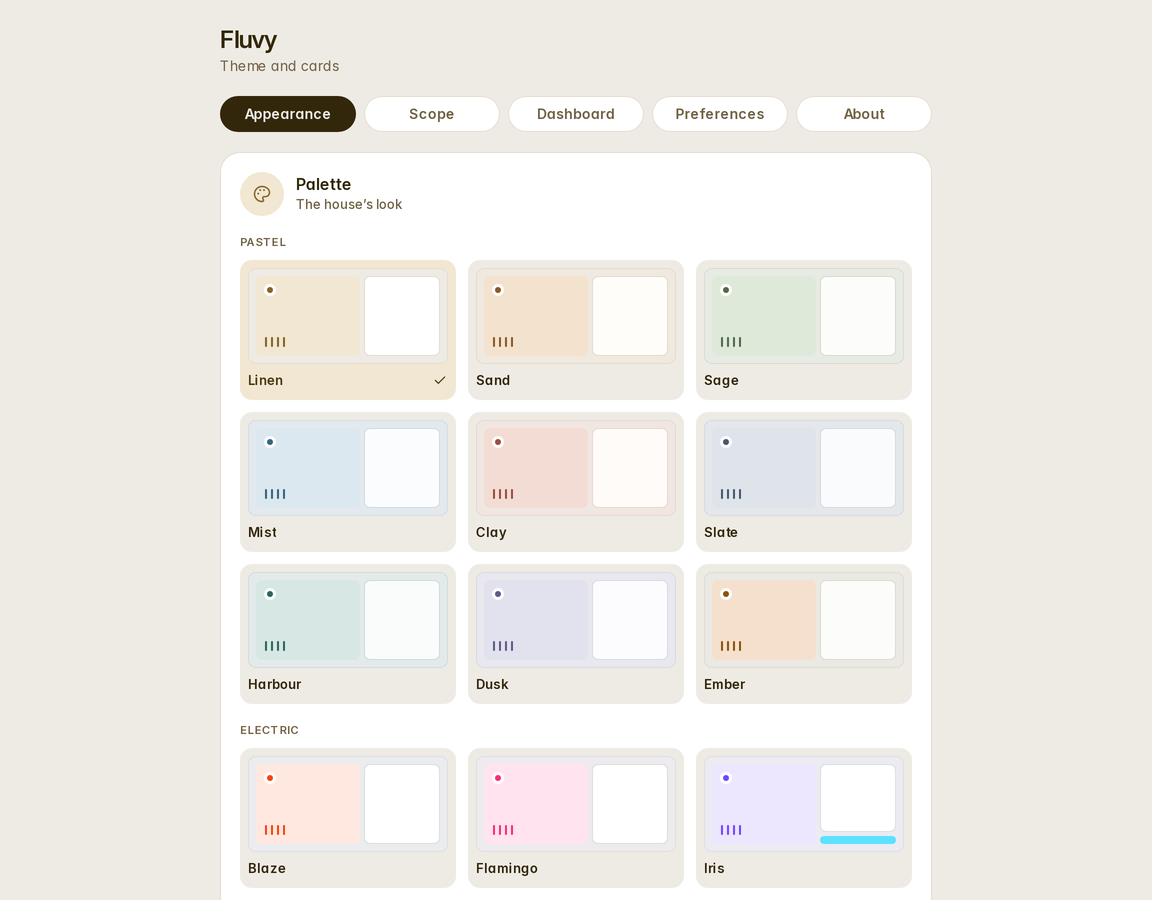
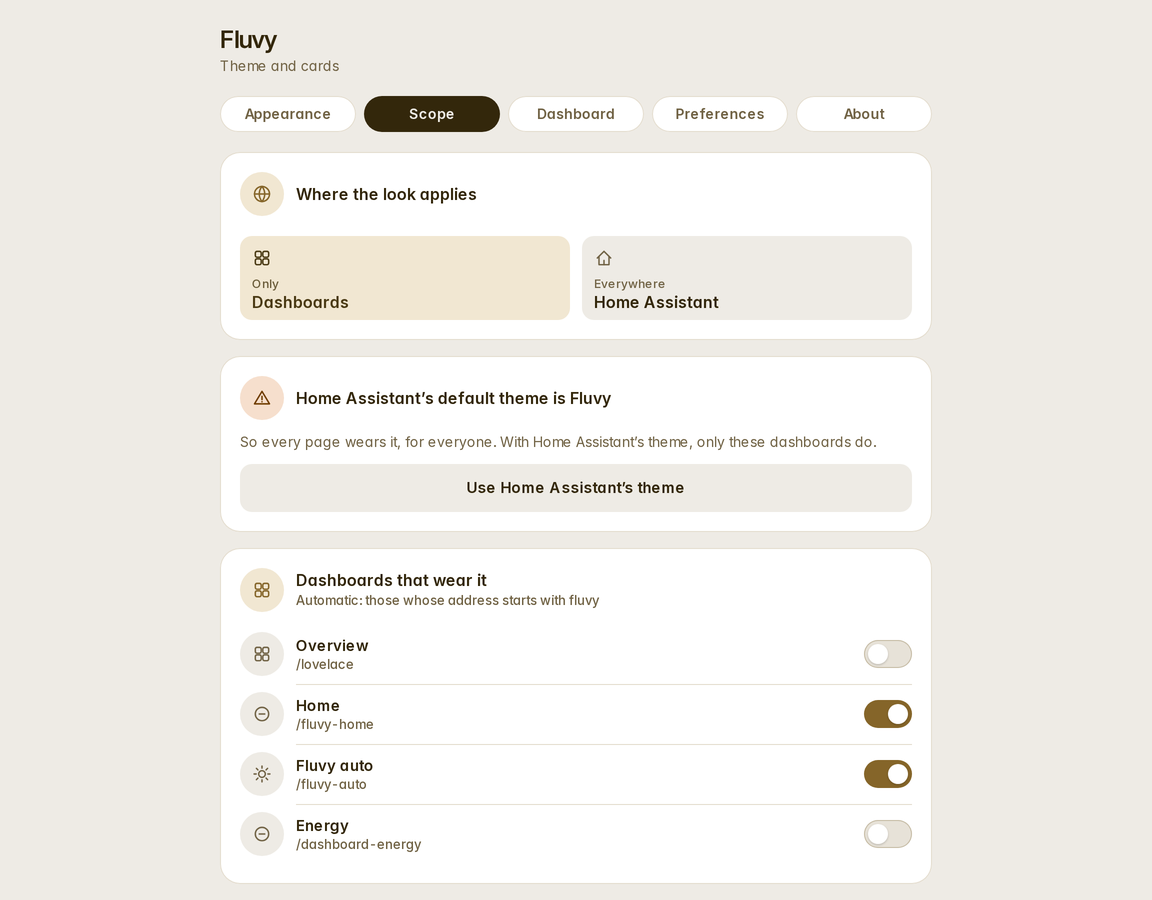
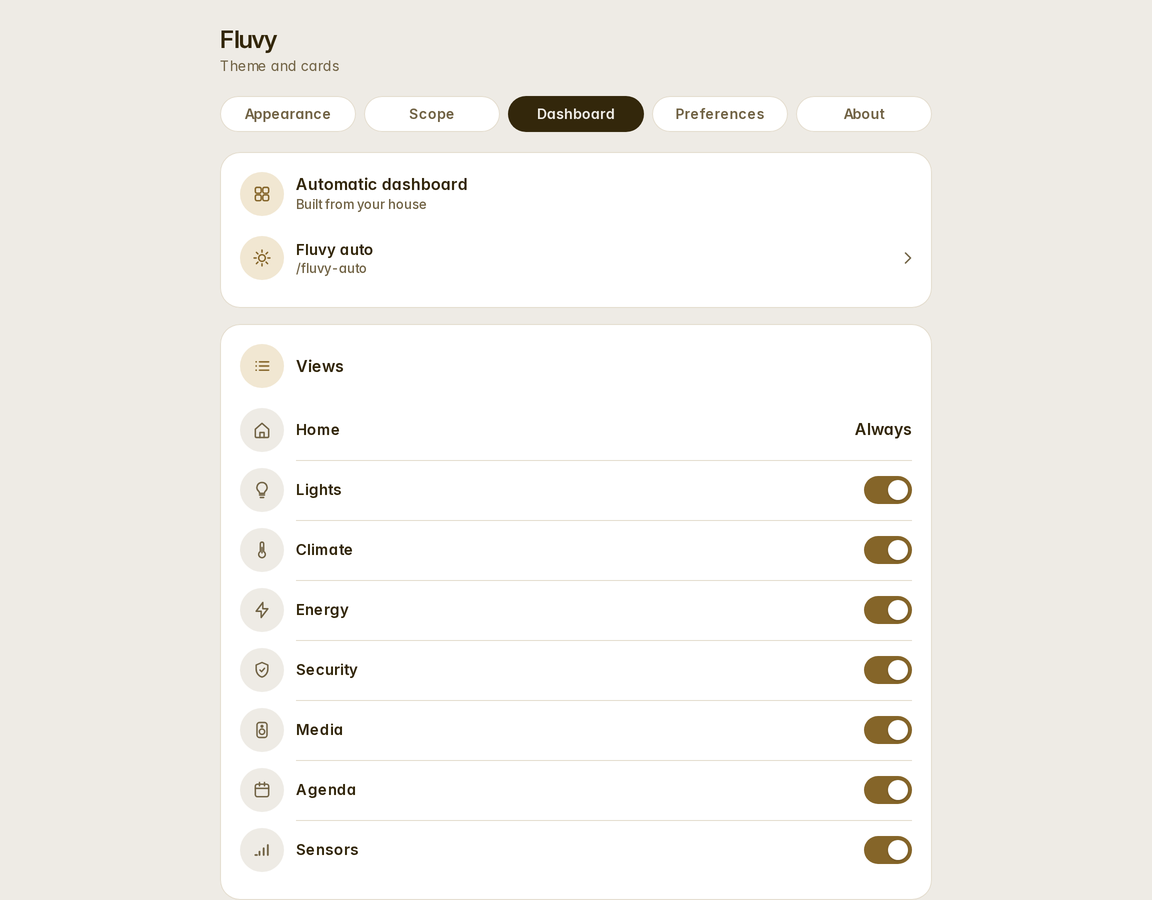
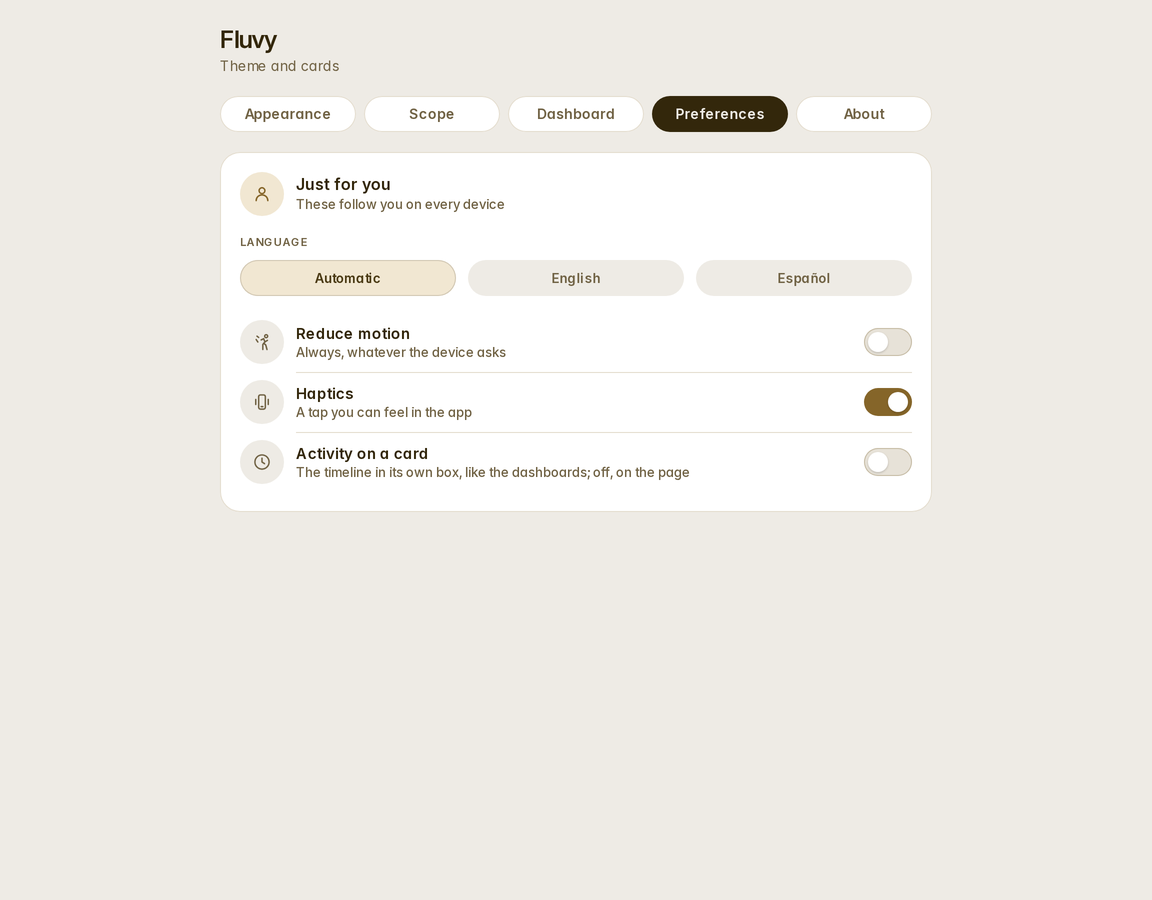
Fluvy in the sidebar: fifteen palettes in a pastel and an electric line, or your own accent with every contrast checked; three shapes; where the look applies; the automatic dashboard; and each person's own preferences — language, motion, haptics, a palette of their own. Changes apply live on every device, no reload.
One line — strategy: { type: custom:fluvy-home } — and Fluvy reads your areas, devices, entities and energy
preferences and builds Home, Rooms, Lights, Climate, Energy, Security, Media, Agenda and Sensors: lights grouped by
room, a card a room that opens the room's own page, appliances with their readings, the running thermostat first,
the home's forecast, the whole Energy dashboard read (every grid connection, the battery's charge, water and gas),
batteries and phones told apart. Four more templates build
a dashboard each — Rooms (a tab a floor), Energy, Security and a Wall for a tablet — and the panel
creates any of them with one tap. Every one is rebuilt every time it opens, so a new device simply shows up.
How they read a home.
- One theme, light and dark, generated from the same tokens the cards are drawn with.
- Forty-nine cards with editor forms, picker previews, and
unavailable,unknownand missing states drawn on purpose. - Energy as your meters read it: a house that imports and exports at once shows both, per phase; with nothing configured the cards read the Energy dashboard, and a day, a week or a month add up to its own figures.
- Five automatic dashboards built from your registries: the home, the rooms, the energy, the security, a wall.
- Wall mode for a tablet: no sidebar, no header, a screensaver with the clock, dark at night, the screen kept
awake —
?kioskon the dashboard's address and the tablet remembers, a × in the corner is the way out. - A settings panel for the house and for each person.
- Activity and History pages in the same idiom.
- Everywhere: Home Assistant's own pages in the same design while it wears the Fluvy theme.
- Eight languages — English, Spanish, German, Dutch, French, Italian, Brazilian Portuguese and Turkish — in every card, page and dialog, each fetched only when spoken.
- No telemetry, no network calls of its own, no dependency but Lit, pinned to Home Assistant's version.
Fluvy needs Home Assistant 2026.9 or newer, HACS, and one line most installations already have in
configuration.yaml — the theme is a file in your themes folder, and this is how Home Assistant reads it:
frontend:
themes: !include_dir_merge_named themes- Until Fluvy is listed in HACS's default store, add it once: in HACS, open the menu (⋮) → Custom
repositories, add
https://github.com/acosta290/fluvywith the type Integration — or click the button above, which fills the dialog in. - Search for Fluvy in HACS and download it.
- Restart Home Assistant.
- Go to Settings → Devices & services → Add integration, search for Fluvy and add it. There is nothing to configure: the integration puts the settings panel in the sidebar, loads Fluvy on every page and installs the theme.
- Reload the browser, then choose the Fluvy theme: in your profile (Theme → Fluvy), or from the panel's Scope tab, which offers it.
Without HACS: download fluvy.zip from the latest release,
unzip it into <config>/custom_components/fluvy/, restart, and continue at step 4.
If something is missing — the theme line above, a resource that has to be added by hand because your dashboards are configured in YAML, an old manual install — Home Assistant tells you in Settings → System → Repairs, with exactly what to add or remove.
Open Fluvy in the sidebar.
- Appearance — the palette, the shape and the buttons, for the house; each person can keep their own.
- Scope — where the look applies: your dashboards only, or everywhere in Home Assistant; whether the frame, the icons and the pages are Fluvy's.
- Dashboards — create any of the five automatic dashboards with one tap and set its options, or add a
dashboard of your own with
strategy: { type: custom:fluvy-home }(orfluvy-rooms,fluvy-energy,fluvy-security,fluvy-wall) in its raw configuration. - Wall — what this tablet is, which dashboards are walls, the screensaver, day and night, the background.
- Preferences — language, motion and haptics, per person.
The cards are in the card picker under Fluvy · …, each with a preview; docs/cards.md lists them with their
options.
| Installation | HACS or the release zip, updating, uninstalling, what the integration registers, the Repairs it can raise |
| Getting started | the first ten minutes |
| The settings panel | the six tabs, house and personal settings, where they are stored |
| The theme | palettes, custom accents, shapes, the tokens |
| The cards | every card, with its configuration |
| The automatic dashboards | what the five templates build from your home, and how to steer them |
| Wall mode | a tablet on the wall: the kiosk, the screensaver, day and night |
| Activity and History | the two pages |
| Everywhere | what the shell restyles, and what to expect after a Home Assistant release |
| Troubleshooting | when something looks wrong |
| Development | the repository, the build, the tools |
| Design language | the specification every card is built and reviewed against |
Home Assistant 2026.9 or newer. The theme, the shell and the pages are checked against each Home Assistant
release; a release can change a page the shell restyles, and docs/shell.md says what happens then. Fluvy runs in
every current browser and in the Companion apps. Lit is bundled, pinned to the version Home Assistant ships; there
is no other runtime dependency, and Fluvy makes no network requests of its own.
Issues and pull requests are welcome. CONTRIBUTING.md has the development setup, the conventions, and the
licensing terms a contribution accepts; CODE_OF_CONDUCT.md applies to every space of the project.
Fluvy is free software under the GNU General Public License v3.0: use it, change it and share it; whatever you distribute that is built on it stays under the same licence, with its source. Third-party work it ships is listed in THIRD_PARTY_NOTICES.md.
Lit (Google, BSD-3-Clause); Material Design Icons (Pictogrammers, Apache-2.0), used to map Home Assistant's icons to Fluvy's glyphs; Inter (The Inter Project Authors, SIL OFL 1.1); and Home Assistant and its frontend (Apache-2.0), which Fluvy is built for and is not affiliated with.